
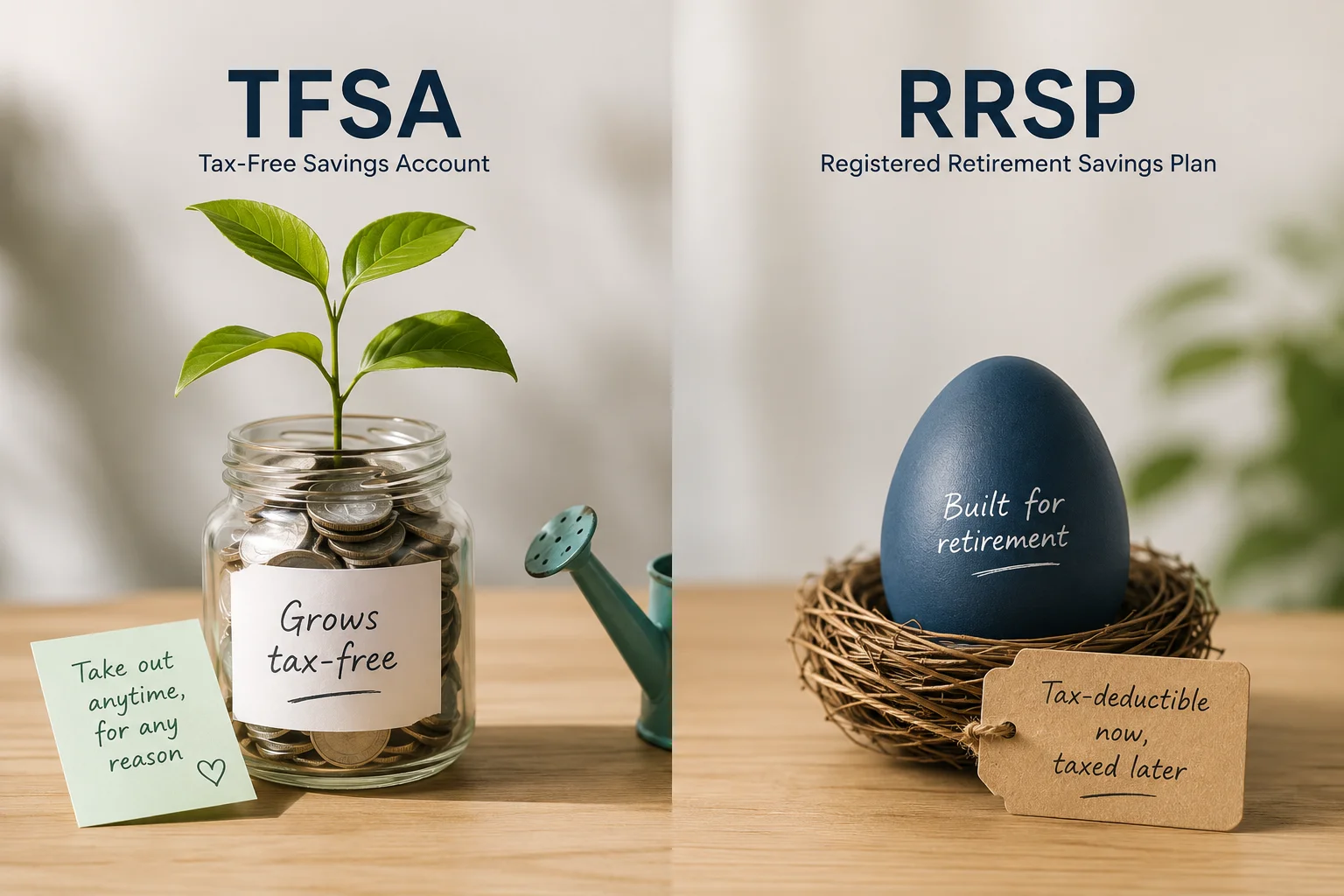
If you want tax-free growth and easy access to your money, a TFSA is usually the best place to start. If you're in a high tax bracket today and saving for retirement, an RRSP often wins because of the upfront tax deduction. For many Canadians, the smartest strategy is using both — the key is knowing which one to prioritize for your situation.
Below is a simple, no-jargon guide to help you decide.
A Tax-Free Savings Account (TFSA) lets your investments grow completely tax-free. You contribute money you've already paid tax on, and you never pay tax on the growth or on withdrawals. You can take money out anytime, for any reason, and you get that contribution room back the following year.
👉 Official details and current contribution limits: CRA — Tax-Free Savings Account and TFSA contributions.
A Registered Retirement Savings Plan (RRSP) is built for retirement. Your contributions are tax-deductible, which can lower your income tax this year. Your investments grow tax-deferred, and you pay tax later when you withdraw — usually in retirement, when your income (and tax rate) may be lower.
👉 Official details: CRA — Registered Retirement Savings Plan (RRSP).
| Feature | RRSP | TFSA |
|---|---|---|
| Tax on contributions | Tax-deductible (lowers this year's income) | No deduction (after-tax money) |
| Tax on growth | Tax-deferred | Tax-free |
| Tax on withdrawals | Taxed as income | Not taxed |
| Best for | Retirement, high earners | Flexibility, any goal, lower earners |
| Withdrawal flexibility | Limited (tax + lost room) | Anytime, room comes back |
An RRSP usually makes more sense when:
A TFSA is often the better starting point when:
Yes — and many Canadians should. A common approach is to use the TFSA for flexible, tax-free savings and the RRSP for retirement and tax relief in higher-earning years. The right mix depends on your income, goals, and timeline.
If you're a newcomer to Canada, you generally start building TFSA room in the year you become a resident (age 18+), while RRSP room is based on your Canadian earned income. Understanding this early helps you avoid over-contributing and make the most of both accounts. Related registered accounts worth knowing: the First Home Savings Account (FHSA) for your first home, and the RESP for your children's education.
For most first-time or lower-income savers, a TFSA is the better starting point thanks to its flexibility and tax-free withdrawals.
No. TFSA withdrawals are completely tax-free, and you get the contribution room back the next calendar year.
Yes. You can contribute to both, up to your personal limits, and many Canadians use them together.
The CRA charges a penalty on excess contributions. Always check your current limit on the official CRA pages linked above or with an advisor.
Written by Yasmin Bedoya, Independent Insurance & Financial Advisor in Calgary, Alberta — serving families, newcomers, and business owners across Canada in English and Spanish.
This article is general educational information, not personalized financial advice. Rules and limits change; always confirm on the official CRA links above or get advice for your situation.
Not sure which account fits you? Book a free, no-pressure consultation — in English or Spanish.
Book a Consultation